Electrochemistry and Electrocatalysis
Chemistry under potential, made visible
Trusted by





















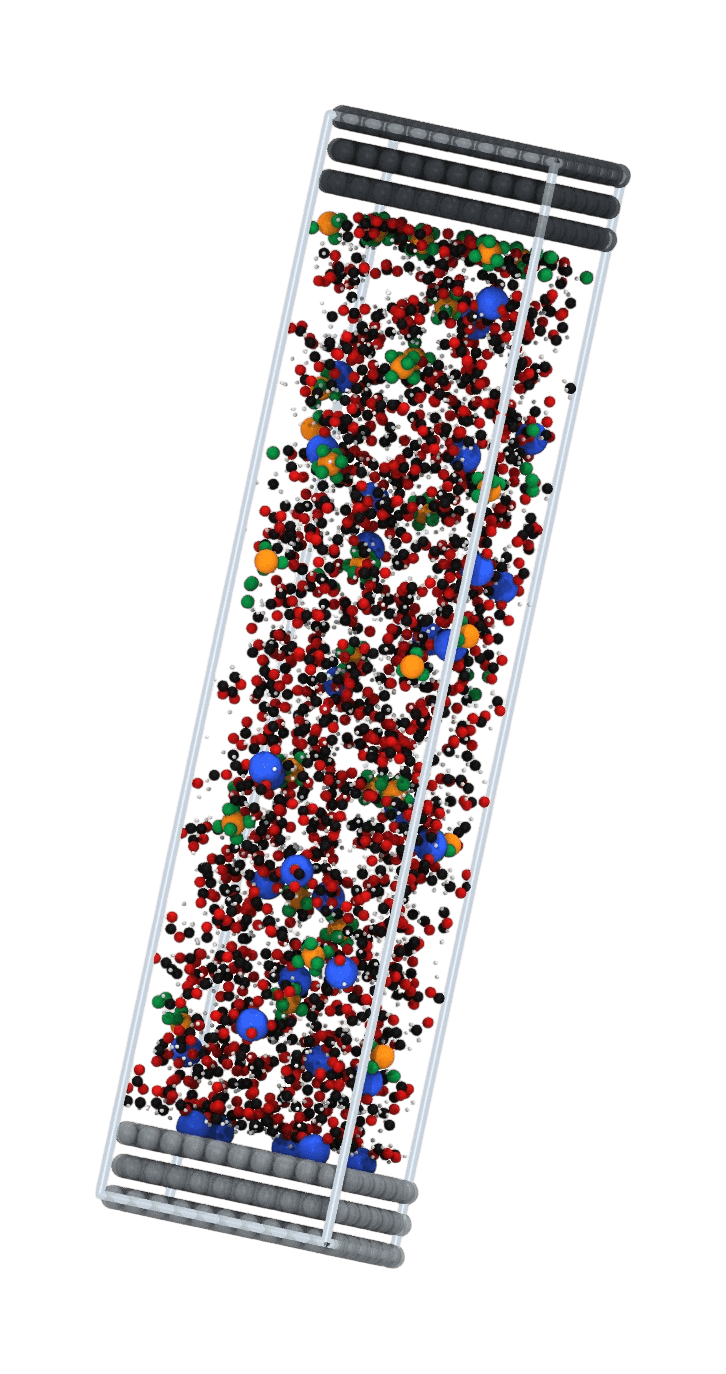
Electrolyzers, fuel cells, plating baths and molten-salt reactors depend on liquid chemistry at charged interfaces. Testing reveals performance, not the molecular events that drive stability, degradation or failure at the electrode.
We help R&D teams model electrochemical interfaces so you understand breakdown pathways, screen safer alternatives and reduce costly rebuild-and-test cycles.
Faster formulation decisions. Lower experimental risk. Clearer routes beyond Cr(VI), PFAS and other constrained chemistries.
Screen non-PFAS ionomers before synthesis
Replacing Nafion-family ionomers means screening new chemistries with little existing data. But before synthesis, casting and membrane testing, the first question is simpler:
Does the ionomer behave well enough in solution to be worth making?
Processability, aggregation, solvation and molecular stability all begin in the liquid phase, where simulation can screen candidates faster.
Simulation helps discard weak candidates before synthesis, reducing costly casting and testing cycles.


Chemical and electrochemical stability
which functional groups degrade first, by which mechanism and under which conditions

Processability
viscosity, density, and diffusivity across solvent and concentration space

Solvation and aggregation
how ionomer chains interact with solvent and with each other

Candidate ranking
prioritising structures before synthesis, casting, and stack integration
Validate on Safe Salts. Prioritise the Right Melts.
Actinide-bearing melt measurements are expensive, slow and difficult to scale across a full composition matrix. Reactor design needs density, viscosity, conductivity, diffusion, speciation, and electrochemical stability data across multi-component molten salts. But hot-cell campaigns and national lab partnerships can take years to plan and execute.
Compular Lab helps you narrow a large composition matrix into a focused set of candidates worth measuring mapped across targeted composition and temperature ranges. Benchmark simulations against well-characterised systems such as NaCl–KCl and LiF–NaF–KF, then use the validated workflow to shortlist actinide-bearing compositions worth measuring.
Transport properties
density, viscosity, conductivity, and diffusion across composition and temperature space
Electrochemical stability data
active redox couples, corrosion-relevant species and breakdown products near structural materials
Speciation in complex melts
dominant coordination environments and how they shift with temperature and composition
Electroplating & Surface
Treatment
Production-Ready Plating Chemistry, Fasterion-Ready Plating Chemistry, Faster
As Cr(VI) restrictions tighten, plating teams need faster routes to production-ready trivalent chromium and alternative passivation systems.
Matching hexavalent performance requires more than replacing one ingredient. Complexation, additives, pH, temperature, and current density all interact driving brightness, throwing power, corrosion resistance, and bath stability.
Hull cell testing remains essential, but it is slow when every variable changes the outcome.
Compular Lab models plating-bath chemistry before production trials, helping teams understand speciation, additive stability, transport, and electrode-interface behaviour before committing to line trials.
Electrochemical stability
which metal complexes and additives reduce or oxidise, and at what potential
Speciation
which complexes dominate as composition and pH change
Transport properties
conductivity and viscosity across temperature and bath composition
Interface structure
how dissolved species arrange at the charged metal surface during plating
Hydrogen Electrolyzers
Stop screening electrolyte and ionomer chemistry blind.
In PEM, AEM, and alkaline systems, liquid-phase chemistry drives stack performance, durability and failure.
Every formulation change can shift conductivity, viscosity, speciation, and degradation. For ionomer precursors, monomer and oligomer behaviour in solution matters before polymerisation and membrane casting
Electrochemical stability windows
which bonds break first, and at what potential
Decomposition pathways
what fragments form and which products accumulate
Transport and speciation
across concentration and temperature ranges
Electrode-interface behaviour
how the electrolyte restructures under applied potential
Catalyst Ink Formulation
Catalyst ink failure is expensive. Predict it earlier.
You tune Pt/C or IrO₂ inks by adjusting ionomer loading and water/alcohol ratio until DLS, viscosity, and CCM performance look right. But a key driver being ionomer coverage on the catalyst surface can shift dramatically with solvent choice, often becoming clear only after coating, drying and testing.
As PFAS pressure pushes teams beyond Nafion, the design space resets: new ionomers, new solvents, new dispersion behaviour and new failure modes.
Compular Lab models catalyst–ionomer–solvent interactions before coating, helping you understand dispersion, surface coverage, viscosity, and PFAS-free reformulation before wasting precious catalyst on failed CCM trials.
Built for PEM fuel cell and electrolyzer inks, including Nafion and alternative ionomers, water/IPA/NPA solvent systems, Pt/C catalysts, and IrO₂ supports. Also applicable to CO₂ reduction electrolyte formulation.
Solvation and aggregation
how solvent dielectric constant and composition affect ionomer behaviour and catalyst coverage
Ionomer stability
which PFAS-free candidates survive operating conditions, which degrade, and why
Ink transport properties
viscosity, density, and diffusivity across solvent and composition space
Surface interactions
how ionomers arrange on Pt or IrO₂ in your specific solvent system
Electrochemistry and Electrocatalysis
Electrochemistry and Electrocatalysis
Chemistry under potential, made visible

Electrochemistry and Electrocatalysis
Chemistry under potential, made visible
Trusted by
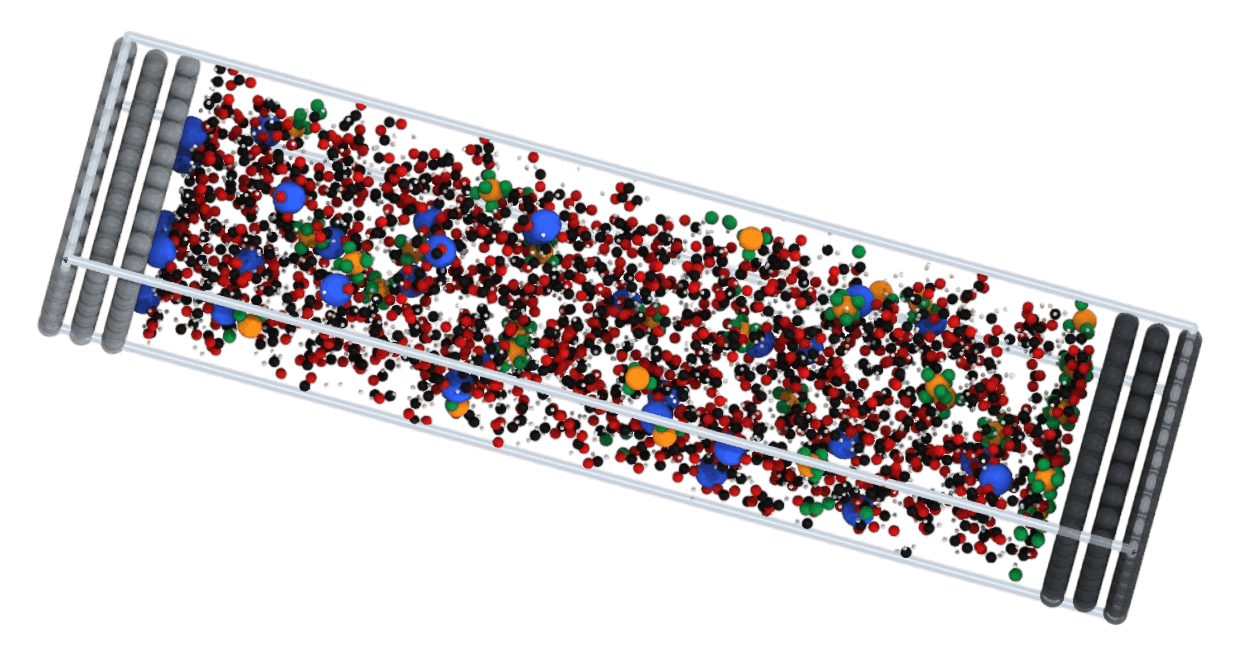
Electrolyzers, fuel cells, plating baths and molten-salt reactors depend on liquid chemistry at charged interfaces. Testing reveals performance, not the molecular events that drive stability, degradation or failure at the electrode.
We help R&D teams model electrochemical interfaces so you understand breakdown pathways, screen safer alternatives and reduce costly rebuild-and-test cycles.
Faster formulation decisions. Lower experimental risk. Clearer routes beyond Cr(VI), PFAS and other constrained chemistries.
Molten Salt Reactors
Fuel Cell Components
Screen non-PFAS ionomers before synthesis
Actinide-bearing melt measurements are expensive, slow and difficult to scale across a full composition matrix. Reactor design needs density, viscosity, conductivity, diffusion, speciation, and electrochemical stability data across multi-component molten salts. But hot-cell campaigns and national lab partnerships can take years to plan and execute.
Compular Lab helps you narrow a large composition matrix into a focused set of candidates worth measuring mapped across targeted composition and temperature ranges. Benchmark simulations against well-characterised systems such as NaCl–KCl and LiF–NaF–KF, then use the validated workflow to shortlist actinide-bearing compositions worth measuring.
Replacing Nafion-family ionomers means screening new chemistries with little existing data. But before synthesis, casting and membrane testing, the first question is simpler:
Does the ionomer behave well enough in solution to be worth making?
Processability, aggregation, solvation and molecular stability all begin in the liquid phase, where simulation can screen candidates faster.
Simulation helps discard weak candidates before synthesis, reducing costly casting and testing cycles.
Transport properties
density, viscosity, conductivity, and diffusion across composition and temperature space
Electrochemical stability data
active redox couples, corrosion-relevant species and breakdown products near structural materials
Speciation in complex melts
dominant coordination environments and how they shift with temperature and composition
Chemical and electrochemical stability
which functional groups degrade first, by which mechanism and under which conditions
Chemical and electrochemical stability
which functional groups degrade first, by which mechanism and under which conditions
Processability
viscosity, density, and diffusivity across solvent and concentration space
Processability
viscosity, density, and diffusivity across solvent and concentration space
Solvation and aggregation
how ionomer chains interact with solvent and with each other
Solvation and aggregation
how ionomer chains interact with solvent and with each other
Candidate ranking
prioritising structures before synthesis, casting, and stack integration
Candidate ranking
prioritising structures before synthesis, casting, and stack integration
Molten Salt Reactors
Validate on Safe Salts. Prioritise the Right Melts.
Actinide-bearing melt measurements are expensive, slow and difficult to scale across a full composition matrix. Reactor design needs density, viscosity, conductivity, diffusion, speciation, and electrochemical stability data across multi-component molten salts. But hot-cell campaigns and national lab partnerships can take years to plan and execute.
Compular Lab helps you narrow a large composition matrix into a focused set of candidates worth measuring mapped across targeted composition and temperature ranges. Benchmark simulations against well-characterised systems such as NaCl–KCl and LiF–NaF–KF, then use the validated workflow to shortlist actinide-bearing compositions worth measuring.
Transport properties
density, viscosity, conductivity, and diffusion across composition and temperature space
Transport properties
density, viscosity, conductivity, and diffusion across composition and temperature space
Electrochemical stability data
active redox couples, corrosion-relevant species and breakdown products near structural materials
Electrochemical stability data
active redox couples, corrosion-relevant species and breakdown products near structural materials
Speciation in complex melts
dominant coordination environments and how they shift with temperature and composition
Speciation in complex melts
dominant coordination environments and how they shift with temperature and composition
As Cr(VI) restrictions tighten, plating teams need faster routes to production-ready trivalent chromium and alternative passivation systems.
Matching hexavalent performance requires more than replacing one ingredient. Complexation, additives, pH, temperature, and current density all interact driving brightness, throwing power, corrosion resistance, and bath stability.
Hull cell testing remains essential, but it is slow when every variable changes the outcome.
Compular Lab models plating-bath chemistry before production trials, helping teams understand speciation, additive stability, transport, and electrode-interface behaviour before committing to line trials.
As Cr(VI) restrictions tighten, plating teams need faster routes to production-ready trivalent chromium and alternative passivation systems.
Matching hexavalent performance requires more than replacing one ingredient. Complexation, additives, pH, temperature, and current density all interact driving brightness, throwing power, corrosion resistance, and bath stability.
Hull cell testing remains essential, but it is slow when every variable changes the outcome.
Compular Lab models plating-bath chemistry before production trials, helping teams understand speciation, additive stability, transport, and electrode-interface behaviour before committing to line trials.
As Cr(VI) restrictions tighten, plating teams need faster routes to production-ready trivalent chromium and alternative passivation systems.
Matching hexavalent performance requires more than replacing one ingredient. Complexation, additives, pH, temperature, and current density all interact driving brightness, throwing power, corrosion resistance, and bath stability.
Hull cell testing remains essential, but it is slow when every variable changes the outcome.
Compular Lab models plating-bath chemistry before production trials, helping teams understand speciation, additive stability, transport, and electrode-interface behaviour before committing to line trials.
Electroplating &
SurfaceTreatment
Electroplating &
SurfaceTreatment
Production-Ready Plating Chemistry, Fasterion-Ready Plating Chemistry, Faster
Production-Ready Plating Chemistry, Fasterion-Ready Plating Chemistry, Faster
Production-Ready Plating Chemistry, Fasterion-Ready Plating Chemistry, Faster
Electrochemical stability
which metal complexes and additives reduce or oxidise, and at what potential
Electrochemical stability
which metal complexes and additives reduce or oxidise, and at what potential
Electrochemical stability
which metal complexes and additives reduce or oxidise, and at what potential
Speciation
which complexes dominate as composition and pH change
Speciation
which complexes dominate as composition and pH change
Speciation
which complexes dominate as composition and pH change
Transport properties
conductivity and viscosity across temperature and bath composition
Transport properties
conductivity and viscosity across temperature and bath composition
Transport properties
conductivity and viscosity across temperature and bath composition
Interface structure
how dissolved species arrange at the charged metal surface during plating
Interface structure
how dissolved species arrange at the charged metal surface during plating
Interface structure
how dissolved species arrange at the charged metal surface during plating
Molten Salt Reactors
Validate on Safe Salts. Prioritise the Right Melts.
Actinide-bearing melt measurements are expensive, slow and difficult to scale across a full composition matrix. Reactor design needs density, viscosity, conductivity, diffusion, speciation, and electrochemical stability data across multi-component molten salts. But hot-cell campaigns and national lab partnerships can take years to plan and execute.
Compular Lab helps you narrow a large composition matrix into a focused set of candidates worth measuring mapped across targeted composition and temperature ranges. Benchmark simulations against well-characterised systems such as NaCl–KCl and LiF–NaF–KF, then use the validated workflow to shortlist actinide-bearing compositions worth measuring.
Transport properties
density, viscosity, conductivity, and diffusion across composition and temperature space
Transport properties
density, viscosity, conductivity, and diffusion across composition and temperature space
Electrochemical stability data
active redox couples, corrosion-relevant species and breakdown products near structural materials
Electrochemical stability data
active redox couples, corrosion-relevant species and breakdown products near structural materials
Speciation in complex melts
dominant coordination environments and how they shift with temperature and composition
Speciation in complex melts
dominant coordination environments and how they shift with temperature and composition
Electrochemical stability windows
which bonds break first, and at what potential
Electrochemical stability windows
which bonds break first, and at what potential
Decomposition pathways
what fragments form and which products accumulate
Decomposition pathways
what fragments form and which products accumulate
Transport and speciation
across concentration and temperature ranges
Transport and speciation
across concentration and temperature ranges
Electrode-interface behaviour
how the electrolyte restructures under applied potential
Electrode-interface behaviour
how the electrolyte restructures under applied potential
Hydrogen Electrolyzers
Stop screening electrolyte and ionomer chemistry blind.
In PEM, AEM, and alkaline systems, liquid-phase chemistry drives stack performance, durability and failure.
Every formulation change can shift conductivity, viscosity, speciation, and degradation. For ionomer precursors, monomer and oligomer behaviour in solution matters before polymerisation and membrane casting
Catalyst Ink
Formulation
Catalyst Ink Formulation
Catalyst ink failure is expensive. Predict it earlier.
Catalyst ink failure is expensive. Predict it earlier.
Catalyst ink failure is expensive. Predict it earlier.
You tune Pt/C or IrO₂ inks by adjusting ionomer loading and water/alcohol ratio until DLS, viscosity, and CCM performance look right. But a key driver being ionomer coverage on the catalyst surface can shift dramatically with solvent choice, often becoming clear only after coating, drying and testing.
As PFAS pressure pushes teams beyond Nafion, the design space resets: new ionomers, new solvents, new dispersion behaviour and new failure modes.
Compular Lab models catalyst–ionomer–solvent interactions before coating, helping you understand dispersion, surface coverage, viscosity, and PFAS-free reformulation before wasting precious catalyst on failed CCM trials.
Built for PEM fuel cell and electrolyzer inks, including Nafion and alternative ionomers, water/IPA/NPA solvent systems, Pt/C catalysts, and IrO₂ supports. Also applicable to CO₂ reduction electrolyte formulation.
You tune Pt/C or IrO₂ inks by adjusting ionomer loading and water/alcohol ratio until DLS, viscosity, and CCM performance look right. But a key driver being ionomer coverage on the catalyst surface can shift dramatically with solvent choice, often becoming clear only after coating, drying and testing.
As PFAS pressure pushes teams beyond Nafion, the design space resets: new ionomers, new solvents, new dispersion behaviour and new failure modes.
Compular Lab models catalyst–ionomer–solvent interactions before coating, helping you understand dispersion, surface coverage, viscosity, and PFAS-free reformulation before wasting precious catalyst on failed CCM trials.
Built for PEM fuel cell and electrolyzer inks, including Nafion and alternative ionomers, water/IPA/NPA solvent systems, Pt/C catalysts, and IrO₂ supports. Also applicable to CO₂ reduction electrolyte formulation.
You tune Pt/C or IrO₂ inks by adjusting ionomer loading and water/alcohol ratio until DLS, viscosity, and CCM performance look right. But a key driver being ionomer coverage on the catalyst surface can shift dramatically with solvent choice, often becoming clear only after coating, drying and testing.
As PFAS pressure pushes teams beyond Nafion, the design space resets: new ionomers, new solvents, new dispersion behaviour and new failure modes.
Compular Lab models catalyst–ionomer–solvent interactions before coating, helping you understand dispersion, surface coverage, viscosity, and PFAS-free reformulation before wasting precious catalyst on failed CCM trials.
Built for PEM fuel cell and electrolyzer inks, including Nafion and alternative ionomers, water/IPA/NPA solvent systems, Pt/C catalysts, and IrO₂ supports. Also applicable to CO₂ reduction electrolyte formulation.
Solvation and aggregation
how solvent dielectric constant and composition affect ionomer behaviour and catalyst coverage
Solvation and aggregation
how solvent dielectric constant and composition affect ionomer behaviour and catalyst coverage
Solvation and aggregation
how solvent dielectric constant and composition affect ionomer behaviour and catalyst coverage
Ionomer stability
which PFAS-free candidates survive operating conditions, which degrade, and why
Ionomer stability
which PFAS-free candidates survive operating conditions, which degrade, and why
Ionomer stability
which PFAS-free candidates survive operating conditions, which degrade, and why
Ink transport properties
viscosity, density, and diffusivity across solvent and composition space
Ink transport properties
viscosity, density, and diffusivity across solvent and composition space
Ink transport properties
viscosity, density, and diffusivity across solvent and composition space
Surface interactions
how ionomers arrange on Pt or IrO₂ in your specific solvent system
Surface interactions
how ionomers arrange on Pt or IrO₂ in your specific solvent system
Surface interactions
how ionomers arrange on Pt or IrO₂ in your specific solvent system
Electrochemical stability windows
which bonds break first, and at what potential
Decomposition pathways
what fragments form and which products accumulate
Transport and speciation
across concentration and temperature ranges
Electrode-interface behaviour
how the electrolyte restructures under applied potential
Hydrogen Electrolyzers
Stop screening electrolyte and ionomer chemistry blind.
In PEM, AEM, and alkaline systems, liquid-phase chemistry drives stack performance, durability and failure.
Every formulation change can shift conductivity, viscosity, speciation, and degradation. For ionomer precursors, monomer and oligomer behaviour in solution matters before polymerisation and membrane casting
Electrochemical stability windows
which bonds break first, and at what potential
Electrochemical stability windows
which bonds break first, and at what potential
Decomposition pathways
what fragments form and which products accumulate
Decomposition pathways
what fragments form and which products accumulate
Transport and speciation
across concentration and temperature ranges
Transport and speciation
across concentration and temperature ranges
Electrode-interface behaviour
how the electrolyte restructures under applied potential
Electrode-interface behaviour
how the electrolyte restructures under applied potential
Electrochemical stability windows
which bonds break first, and at what potential
Decomposition pathways
what fragments form and which products accumulate
Transport and speciation
across concentration and temperature ranges
Electrode-interface behaviour
how the electrolyte restructures under applied potential
Fuel Cell Components
Screen non-PFAS ionomers before synthesis
Replacing Nafion-family ionomers means screening new chemistries with little existing data. But before synthesis, casting and membrane testing, the first question is simpler:
Does the ionomer behave well enough in solution to be worth making?
Processability, aggregation, solvation and molecular stability all begin in the liquid phase, where simulation can screen candidates faster.
Simulation helps discard weak candidates before synthesis, reducing costly casting and testing cycles.
Replacing Nafion-family ionomers means screening new chemistries with little existing data. But before synthesis, casting and membrane testing, the first question is simpler:
Does the ionomer behave well enough in solution to be worth making?
Processability, aggregation, solvation and molecular stability all begin in the liquid phase, where simulation can screen candidates faster.
Simulation helps discard weak candidates before synthesis, reducing costly casting and testing cycles.
Every new electrolyte blend, solvent, salt concentration, or additive candidate means building coin cells, running tests and waiting often for months only to see most candidates fail. Screening even a small set of electrolytes consumes significant time with little insight into solvation, degradation or performance or why one blend outperforms another. Across Li-ion, Na-ion and emerging chemistries and formulation decisions are made with limited understanding.
Electrochemical stability windows
of your solvents and additives: what breaks first, at what potential and via which pathways.
Decomposition pathway mapping
via DFT and transition state theory what fragments form, generating SEI/CEI and causes gassing
Transport properties
(conductivity, viscosity, diffusivity, transference number) across your full composition and temperature space
Solvation structure analysis
analyse dominant coordination shells, how they shift with salt concentration and what drives transport differences between blends.
Chemical and electrochemical stability
which functional groups degrade first, by which mechanism and under which conditions
Chemical and electrochemical stability
which functional groups degrade first, by which mechanism and under which conditions
Processability
viscosity, density, and diffusivity across solvent and concentration space
Processability
viscosity, density, and diffusivity across solvent and concentration space
Solvation and aggregation
how ionomer chains interact with solvent and with each other
Solvation and aggregation
how ionomer chains interact with solvent and with each other
Candidate ranking
prioritising structures before synthesis, casting, and stack integration
Candidate ranking
prioritising structures before synthesis, casting, and stack integration
Frequently Asked Questions
From setup to support, here are the answers you need to launch faster with confidence.
Do I need design or coding experience to use this?
More than just SaaS—perfect for creators, freelancers, and agencies who want sleek, high-performing sites fast.
Can I customize everything in the template?
Is this template only for SaaS founders?
How fast can I get my site live?
Can I use this for client projects?
Is Framer free to use with this template?
What is Compular Lab?
How does Compular Lab help material development?
Who can use Compular Lab?
What types of material properties can Compular Lab analyse?
Can you simulate multi-component systems such as electrolytes or complex formulations?
Can you simulate electrolytes as a function of temperature and voltage?
Do you provide molecular-level insights?
Does Compular Lab run simulations automatically?
Is there a demo or trial version available?
What makes Compular Lab different from traditional material R&D?
Frequently Asked Questions
Frequently Asked Questions
What is Compular Lab?
How does Compular Lab help material development?
Who can use Compular Lab?
What types of material properties can Compular Lab analyse?
Can you simulate multi-component systems such as electrolytes or complex formulations?
Can you simulate electrolytes as a function of temperature and voltage?
Do you provide molecular-level insights?
Does Compular Lab run simulations automatically?
Is there a demo or trial version available?
What makes Compular Lab different from traditional material R&D?

Accelerate materials discovery
with AI & multiscale simulations.
Compular turns complex molecular design into fast, reliable predictions, helping researchers innovate and drive sustainable solutions.
Accelerate materials discovery
with AI & multiscale simulations.
Compular turns complex molecular design into fast, reliable predictions, helping researchers innovate and drive sustainable solutions.