
Whitepaper

From Molecules to Full Cylindrical Cells: Coupling Atomistic Simulations and Battery Modeling News

From Molecules to Full Cylindrical Cells: Coupling Atomistic Simulations and Battery Modeling News

Image

Rasmus Andersson

CEO at Compular

Accurate electrolyte transport data are essential for predictive battery modeling, yet obtaining them experimentally remains one of the most persistent challenges in electrochemistry. Properties such as ionic conductivity, diffusivity, and transference number are difficult to measure reliably, and reported values in the literature can differ significantly. Even established experimental methods can produce contradictory results due to measurement artifacts, electrode interface effects, or inconsistencies in data interpretation. This uncertainty poses a significant barrier to building high-fidelity battery models. Continuum models like the Doyle-Fuller-Newman pseudo-2D (P2D) formulation rely on a self-consistent set of electrolyte transport parameters to describe ion movement, concentration gradients, and voltage response under various operating conditions. When these parameters are inaccurate or incomplete, model predictions quickly lose reliability, particularly for thick electrodes, high C-rates, or low-temperature operation.


Molecular dynamics (MD) simulations offer an alternative path forward. Instead of relying solely on often complicated experiments, MD can directly predict key electrolyte transport properties from atomic-level interactions, delivering a physically grounded and internally consistent data set. We have previously reported excellent agreement of ionic conductivity, salt diffusion coefficient, thermodynamic factor, and cationic transference number with carefully performed experiments reported in the scientific literature, and demonstrated the combination of MD simulations and P2D modeling in single-cell lithium and sodium-ion batteries.


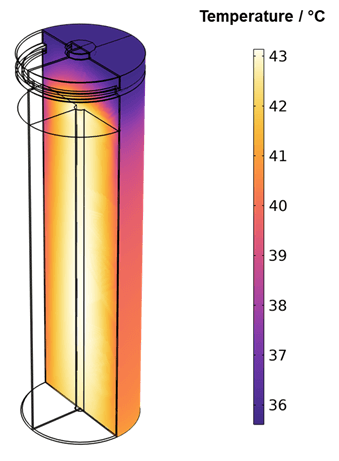
In this collaborative work between the Zentrum für Sonnenenergie- und Wasserstoff-Forschung Baden-Württemberg and Compular, we generalize this workflow to full multilayer cells (in this case, a 21700 NMC811 cylindrical lithium-ion cell) by adding a thermal and a full-cell electrical model, coupled with the P2D electrochemical model, which in turn is fed by the predicted electrolyte transport properties from Compular Lab MD simulations and analysis.


By comparing results under different operating conditions and electrode designs, we showed how detailed electrolyte transport properties can significantly impact the simulated voltage behavior, particularly in demanding regimes such as low temperature, high C-rates, and thick electrodes.


Frequently Asked Questions

From setup to support, here are the answers you need to launch faster with confidence.

Do I need design or coding experience to use this?

More than just SaaS—perfect for creators, freelancers, and agencies who want sleek, high-performing sites fast.

Can I customize everything in the template?

Is this template only for SaaS founders?

How fast can I get my site live?

Can I use this for client projects?

Is Framer free to use with this template?

What is Compular Lab?

How does Compular Lab help material development?

Who can use Compular Lab?

What types of material properties can Compular Lab analyse?

Can you simulate multi-component systems such as electrolytes or complex formulations?

Can you simulate electrolytes as a function of temperature and voltage?

Do you provide molecular-level insights?

Does Compular Lab run simulations automatically?

Is there a demo or trial version available?

What makes Compular Lab different from traditional material R&D?

Frequently Asked Questions

Frequently Asked Questions

What is Compular Lab?

How does Compular Lab help material development?

Who can use Compular Lab?

What types of material properties can Compular Lab analyse?

Can you simulate multi-component systems such as electrolytes or complex formulations?

Can you simulate electrolytes as a function of temperature and voltage?

Do you provide molecular-level insights?

Does Compular Lab run simulations automatically?

Is there a demo or trial version available?

What makes Compular Lab different from traditional material R&D?

Image

Accelerate materials discovery
with AI & multiscale simulations.

Compular turns complex molecular design into fast, reliable predictions, helping researchers innovate and drive sustainable solutions.

Image

Accelerate materials discovery
with AI & multiscale simulations.

Compular turns complex molecular design into fast, reliable predictions, helping researchers innovate and drive sustainable solutions.

Logo

Compular helps teams predict molecular properties faster using multiscale modelling and AI, cutting experimental costs and accelerating innovation.


Newsletter

Get tips, product updates, and insights on working smarter with material R&D

© 2025 Alwork. All rights reserved.

Powered by Framer

Logo

Compular helps teams predict molecular properties faster using multiscale modelling and AI, cutting experimental costs and accelerating innovation.


Newsletter

Get tips, product updates, and insights on working smarter with material R&D

© 2025 Alwork. All rights reserved.

Powered by Framer

Logo

Compular helps teams predict molecular properties faster using multiscale modelling and AI, cutting experimental costs and accelerating innovation.


Newsletter

Get tips, product updates, and insights on working smarter with material R&D

© 2025 Alwork. All rights reserved.

Powered by Framer

Create a free website with Framer, the website builder loved by startups, designers and agencies.