Whitepaper

Solving the problem of missing parameters in cell models

Solving the problem of missing parameters in cell models

Image

Magnus Rahm

CTO at Compular

Is lack of parameters an issue for your battery models?


For most battery developers, simulations are an integral part of the development process. Simulations on the continuum scale require knowledge of the properties of the materials that are being modeled. Sometimes such material properties can be sourced from open databases, but more often than not, they are simply unknowns that need to be guessed or measured. For some properties, relatively straight-forward experimental approaches have been developed, but for others experiments can be both costly and unreliable. Obviously, experimental measurements also require the materials procured, which is unfortunate when the purpose of that is just to make it possible to start simulations.


This is where Compular Lab comes to the rescue. Using entirely physics-based simulations (without the need for training data of any kind), Compular Lab fully characterizes the electrolyte by predicting the four properties required for Doyle–Fuller–Newman simulations: ionic conductivity, transference number, salt diffusivity, and thermodynamic factor. This eliminates the need for experimental measurements of the electrolyte, and unlocks the possibility to swiftly build models at an earlier stage in the R&D process, including for screening electrolyte formulations.


What about the accuracy? 


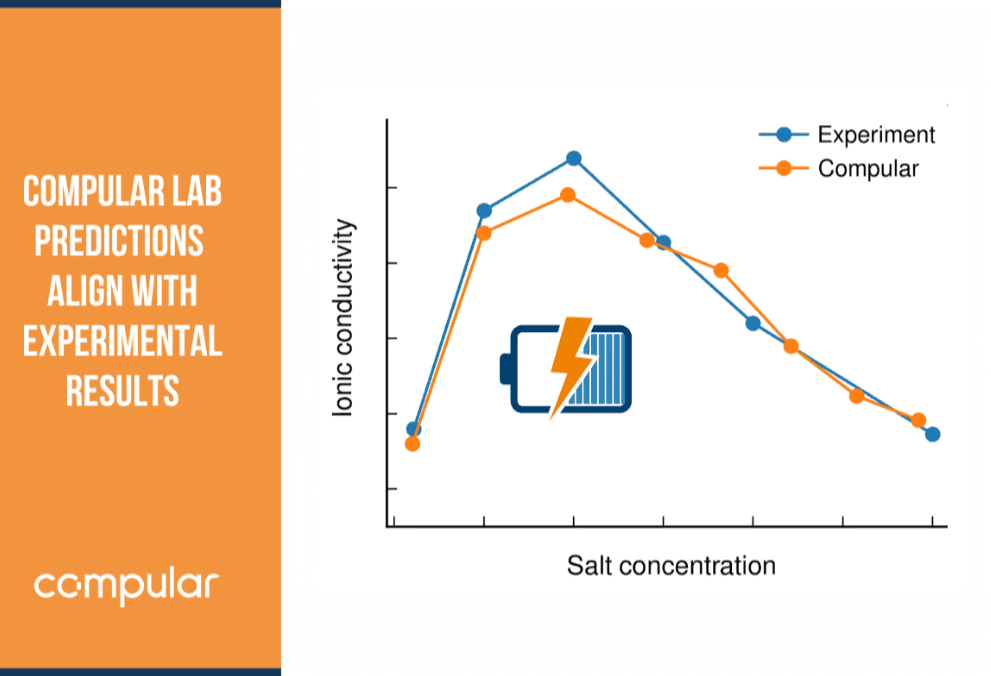
Of course, these predictions are only valuable if they are accurate. To investigate the validity of Compular Lab’s predictions, we have performed an extensive comparison study against the experimental data published by Landesfeind and Gasteiger in Journal of The Electrochemical Society 2019 (166). The results reveal that

  • For ionic conductivity, simulation and experiment match well although some underestimation seems to occur in some cases,

  • For salt diffusivity, simulation and experiment match well, except at very low salt concentrations (around 0.1 M) for which sampling becomes an issue in simulations,

  • For transference number, there are significant differences between simulation and experiment, but such differences exist also between different experimental studies, and there are indications that the simulation may in fact be more reliable,

  • For thermodynamic factor, simulation and experiment match reasonably well, and simulations seem to be less riddled by noise.


These findings makes Compular Lab an affordable and sufficiently accurate avenue to generating the missing electrolyte properties, and may in some cases even be a more reliable approach than experimental measurements, even if both the material and state-of-the-art equipment is available.


The full data and a detailed discussion is available in the whitepaper.


Frequently Asked Questions

From setup to support, here are the answers you need to launch faster with confidence.

Do I need design or coding experience to use this?

More than just SaaS—perfect for creators, freelancers, and agencies who want sleek, high-performing sites fast.

Can I customize everything in the template?

Is this template only for SaaS founders?

How fast can I get my site live?

Can I use this for client projects?

Is Framer free to use with this template?

What is Compular Lab?

How does Compular Lab help material development?

Who can use Compular Lab?

What types of material properties can Compular Lab analyse?

Can you simulate multi-component systems such as electrolytes or complex formulations?

Can you simulate electrolytes as a function of temperature and voltage?

Do you provide molecular-level insights?

Does Compular Lab run simulations automatically?

Is there a demo or trial version available?

What makes Compular Lab different from traditional material R&D?

Frequently Asked Questions

Frequently Asked Questions

What is Compular Lab?

How does Compular Lab help material development?

Who can use Compular Lab?

What types of material properties can Compular Lab analyse?

Can you simulate multi-component systems such as electrolytes or complex formulations?

Can you simulate electrolytes as a function of temperature and voltage?

Do you provide molecular-level insights?

Does Compular Lab run simulations automatically?

Is there a demo or trial version available?

What makes Compular Lab different from traditional material R&D?

Image

Accelerate materials discovery
with AI & multiscale simulations.

Compular turns complex molecular design into fast, reliable predictions, helping researchers innovate and drive sustainable solutions.

Image

Accelerate materials discovery
with AI & multiscale simulations.

Compular turns complex molecular design into fast, reliable predictions, helping researchers innovate and drive sustainable solutions.

Logo

Compular helps teams predict molecular properties faster using multiscale modelling and AI, cutting experimental costs and accelerating innovation.


Newsletter

Get tips, product updates, and insights on working smarter with material R&D

© 2025 Alwork. All rights reserved.

Powered by Framer

Logo

Compular helps teams predict molecular properties faster using multiscale modelling and AI, cutting experimental costs and accelerating innovation.


Newsletter

Get tips, product updates, and insights on working smarter with material R&D

© 2025 Alwork. All rights reserved.

Powered by Framer

Logo

Compular helps teams predict molecular properties faster using multiscale modelling and AI, cutting experimental costs and accelerating innovation.


Newsletter

Get tips, product updates, and insights on working smarter with material R&D

© 2025 Alwork. All rights reserved.

Powered by Framer