News

Rasoul Hashemi
Computational Material Scientist at Compular

In our previous post, we showed that a full DFT redox workflow achieves an MAE of 0.23 V and a concordance index of 0.91 across 155 organic molecules. That protocol is accurate, but it requires a complete thermochemical calculation for each molecule: geometry optimisation of the neutral and charged states, frequency analysis, and a high-level single-point energy. Here we ask a simpler question: how much predictive power do you get before any of that, just from the orbital energies of the neutral molecule?
Computing the energy of the highest occupied molecular orbital (HOMO) or lowest unoccupied molecular orbital (LUMO) takes a fraction of the time. It is widely used as a proxy for oxidation and reduction stability, but rarely tested quantitatively against experiment at scale. We ran that test on the same 155-molecule dataset from Roth, Romero, and Nicewicz (Synlett 2016) that underpins our benchmark.
HOMO vs oxidation potential
The HOMO energy tracks experimental oxidation potentials with R² = 0.746 and a Spearman rank correlation of 0.884 across 113 molecules. More practically, the concordance index (the fraction of molecule pairs that are correctly ranked) is 0.853. That means HOMO alone correctly identifies the easier-to-oxidise molecule in 85% of all pairwise comparisons, without running any redox thermochemistry at all.
LUMO vs reduction potential
The experimental dataset contains far fewer reduction measurements than oxidation ones: 46 molecules versus 113. This reflects what was available to measure, not a gap in our calculations. The reduction potentials in this benchmark span a narrower chemical space, weighted towards aldehydes, ketones, anhydrides, and halogenated compounds.
For that subset, the LUMO energy is a noticeably weaker predictor than HOMO is for oxidation: R² = 0.275, Spearman rank correlation of 0.647, C-index = 0.757. A real trend exists, but the scatter is large.
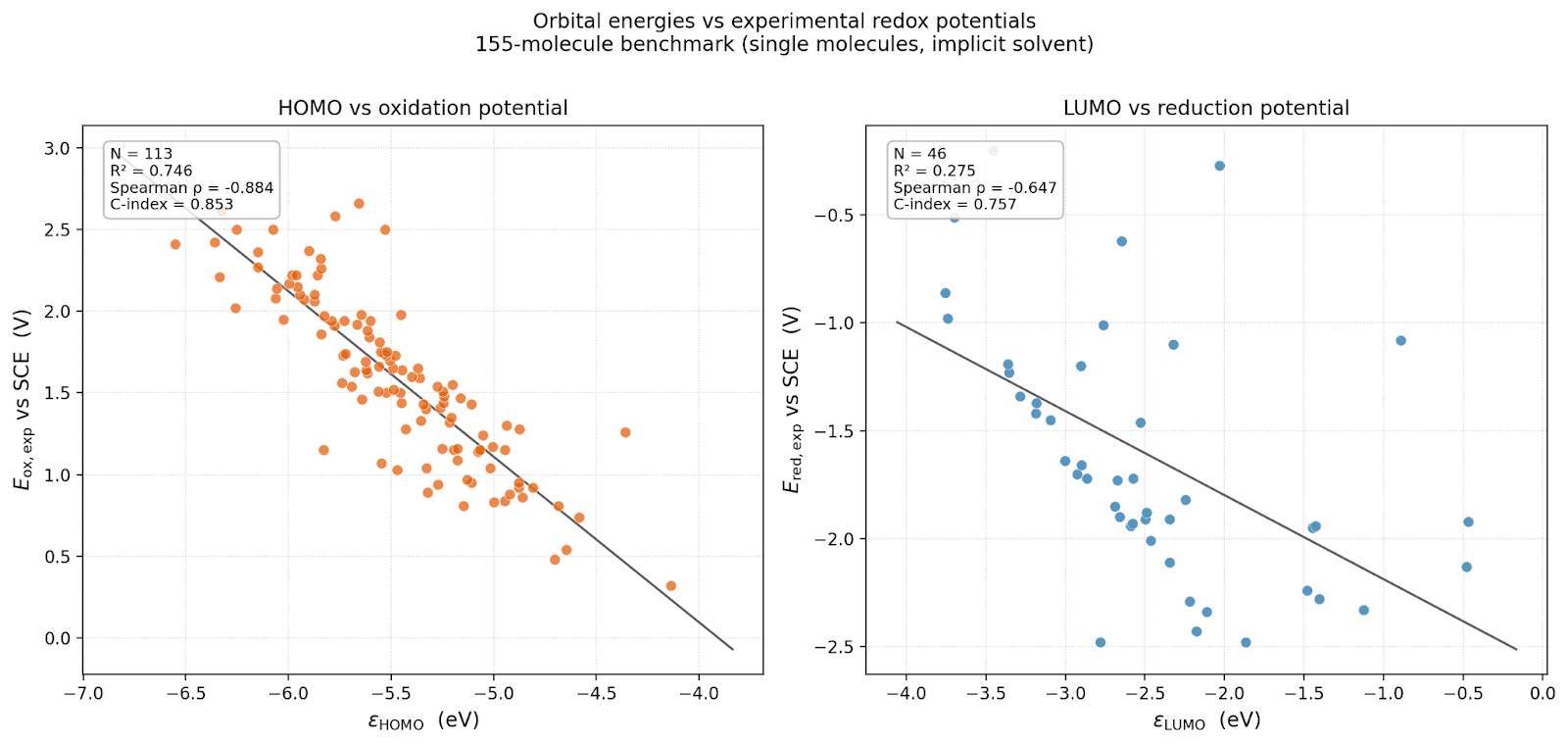
Orbital energies vs experimental redox potentials for 155 organic molecules
Why is HOMO better than LUMO?
The asymmetry is physical. The HOMO is a compact, well-localised orbital that responds predictably to functional-group substitution and is described accurately by standard basis sets. The LUMO is often diffuse or partially unbound in neutral molecules, more sensitive to basis-set completeness, and more easily perturbed by conformational effects. The result is that HOMO energies form a clean, monotonic relationship with oxidation potentials, while LUMO energies show considerably more scatter against reduction potentials.
What C-index tells you that R² does not
R² measures correlation: how much of the variance in experimental redox potential is captured by a linear fit to the orbital energy. C-index measures ranking, which is what screening actually requires. A C-index of 0.853 says that out of every six molecule pairs, HOMO correctly identifies the more oxidation-prone one in five of them.
Compared to the full workflow from our previous post (C-index = 0.91), orbital screening gives up roughly six percentage points of ranking accuracy in exchange for eliminating most of the computational cost. For triaging a large candidate library before committing to full calculations, that trade-off is often worth making.
When to use orbital screening and when not to
HOMO-based screening is a reliable first pass for oxidation stability. LUMO-based screening for reduction is less reliable and should be treated as a rough filter rather than a quantitative prediction. For any candidate where reduction stability matters, such as SEI-forming additives, low-voltage anolytes, or reductive quenching agents, the full calculation from our benchmark workflow is worth running.
To learn more about how Compular can accelerate your redox screening workflows, reach out to info@compulartech.com.