
The Electric Double Layer: Decoding the Birthplace of the SEI

The Electric Double Layer: Decoding the Birthplace of the SEI

Image

Rasoul Hashemi

Computational Materials Scientist, PhD in Physical Chemistry
Image

In the quest for better batteries, the Electric Double Layer (EDL) has emerged as one of the most critical frontiers. While bulk electrolyte properties often dominate discussions, the real action unfolds within just a few nanometers where the liquid electrolyte meets the solid electrode. The structure of this interfacial region governs interfacial resistance, capacitance, and ultimately the composition and stability of the Solid Electrolyte Interphase (SEI).


At Compular, we use confined molecular dynamics simulations under constant potential (CPMD) to directly observe how the EDL organizes itself at operating voltages. This approach allows us to quantify how solvent molecules, anions,  Li⁺, and  electrolyte additives populate and evolve within the EDL and, providing insight into how their collective interactions govern interfacial chemistry and, ultimately, SEI formation.


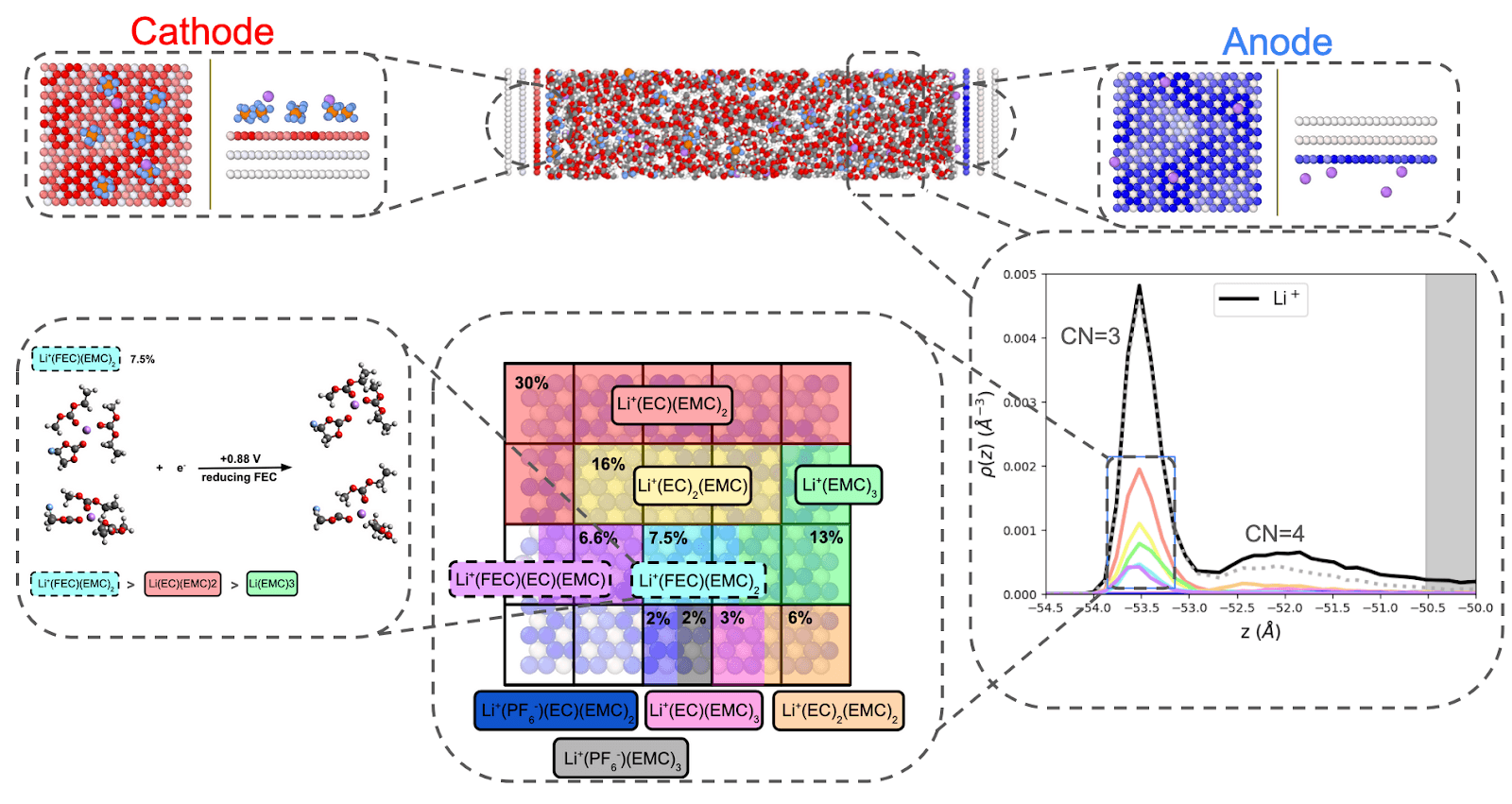
As a representative example, we investigated an electrolyte composed of 1 M LiPF₆ in an approximately 1:2:4 mixture of FEC:EC:EMC at a constant potential of 4 V. Several key insights emerge:

  • Anion exclusion at the anode: PF₆⁻ anions are largely excluded from forming ion pairs with surface Li⁺ cations at the anode.

  • Desolvation-driven surface coordination: For a Li⁺ ion to coordinate directly with the electrode surface, it must shed one of its solvating molecules. Accordingly, all Li⁺ ions observed exhibit a reduced coordination number of 3, compared to the bulk value of 4.2.

  • Recovery of bulk solvation: Moving away from the anode surface, the Li⁺ coordination number gradually returns to its bulk average of approximately 4.2.

  • Cluster-level insight: Using our CHAMPION cluster analysis, we map the relative contributions of distinct solvation and ion-pairing motifs to the Li⁺ EDL structure.

  • Role of FEC additives: FEC appears in approximately 15% of surface-adsorbed Li⁺ clusters, indicating a meaningful interfacial population of adsorbed clusters containing FEC that can contribute to SEI chemistry.

  • Preferred reduction pathways: Redox calculations performed on the identified clusters provide insight into the most likely interfacial reduction mechanisms.

Conclusion


CPMD simulations, when combined with CHAMPION cluster analysis and targeted redox calculations on EDL-derived molecular clusters, provide a powerful and quantitative framework for evaluating how electrolyte solvents and additives influence EDL structure and SEI formation. This methodology enables rational electrolyte design rooted directly in interfacial chemistry. 


Would you be interested in more details on how we can model the EDL and how it could be applied to your R&D? Reach out to us at info@compulartech.com!

Frequently Asked Questions

From setup to support, here are the answers you need to launch faster with confidence.

Do I need design or coding experience to use this?

More than just SaaS—perfect for creators, freelancers, and agencies who want sleek, high-performing sites fast.

Can I customize everything in the template?

Is this template only for SaaS founders?

How fast can I get my site live?

Can I use this for client projects?

Is Framer free to use with this template?

What is Compular Lab?

How does Compular Lab help material development?

Who can use Compular Lab?

What types of material properties can Compular Lab analyse?

Can you simulate multi-component systems such as electrolytes or complex formulations?

Can you simulate electrolytes as a function of temperature and voltage?

Do you provide molecular-level insights?

Does Compular Lab run simulations automatically?

Is there a demo or trial version available?

What makes Compular Lab different from traditional material R&D?

Frequently Asked Questions

Frequently Asked Questions

What is Compular Lab?

How does Compular Lab help material development?

Who can use Compular Lab?

What types of material properties can Compular Lab analyse?

Can you simulate multi-component systems such as electrolytes or complex formulations?

Can you simulate electrolytes as a function of temperature and voltage?

Do you provide molecular-level insights?

Does Compular Lab run simulations automatically?

Is there a demo or trial version available?

What makes Compular Lab different from traditional material R&D?

Image

Accelerate materials discovery
with AI & multiscale simulations.

Compular turns complex molecular design into fast, reliable predictions, helping researchers innovate and drive sustainable solutions.

Image

Accelerate materials discovery
with AI & multiscale simulations.

Compular turns complex molecular design into fast, reliable predictions, helping researchers innovate and drive sustainable solutions.

Logo

Compular helps teams predict molecular properties faster using multiscale modelling and AI, cutting experimental costs and accelerating innovation.


Newsletter

Get tips, product updates, and insights on working smarter with material R&D

© 2026 Compular. All rights reserved.

Logo

Compular helps teams predict molecular properties faster using multiscale modelling and AI, cutting experimental costs and accelerating innovation.


Newsletter

Get tips, product updates, and insights on working smarter with material R&D

© 2026 Compular. All rights reserved.

Logo

Compular helps teams predict molecular properties faster using multiscale modelling and AI, cutting experimental costs and accelerating innovation.


Newsletter

Get tips, product updates, and insights on working smarter with material R&D

© 2026 Compular. All rights reserved.